

If you’ve heard the term thrown around in a manufacturing plant, a hospital quality department, or a competition brochure and quietly nodded along without really knowing what it meant — you’re not alone. A Quality Control Circle (QCC) is one of the most widely used, and most widely misunderstood, quality improvement methodologies in operations today. Here’s what a quality control circle actually is, how it works, and why it still matters decades after it was invented.
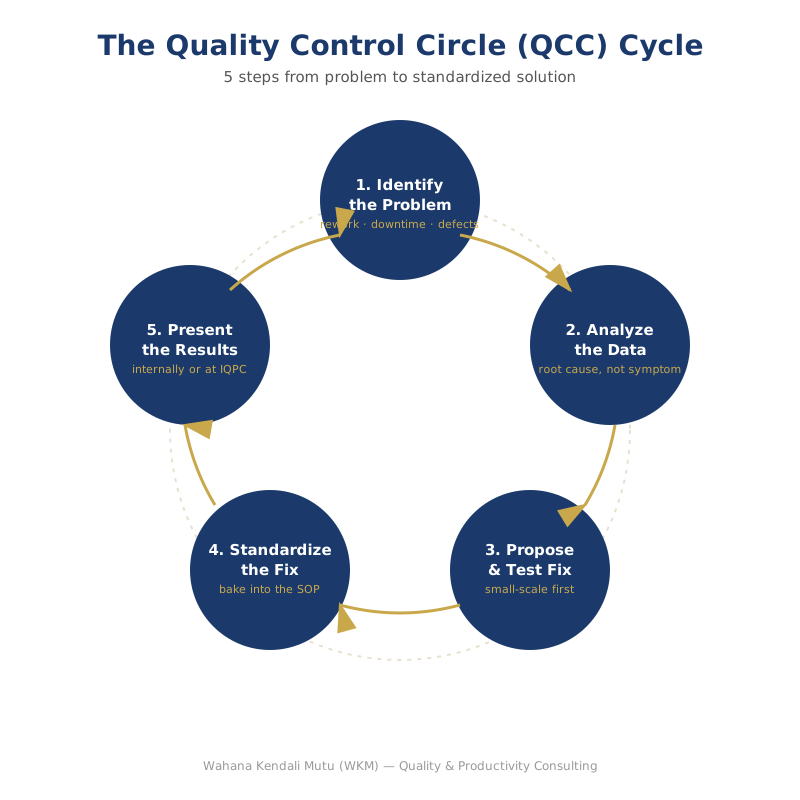
The 5-step Quality Control Circle cycle: identify, analyze, test, standardize, present.
What Is a Quality Control Circle, Exactly?
A Quality Control Circle is a small group of employees — typically 4 to 10 people from the same work area — who voluntarily meet on a regular basis to identify, analyze, and solve problems related to their own work. The concept originated in Japan in the 1960s as part of the broader quality management movement, built on a simple but powerful idea: the people closest to a process are usually the ones best positioned to fix it.
Unlike a top-down improvement initiative imposed by management, a quality control circle is driven by the frontline team itself. That distinction matters more than it sounds — a solution designed by the people who’ll actually execute it tends to survive far longer than one handed down from a consultant’s slide deck.
How a Quality Control Circle Actually Works
Most quality control circle projects follow a structured problem-solving cycle, often referred to as PDCA (Plan-Do-Check-Act) or a similar eight-step method:
- Identify the problem — usually something the team encounters directly: rework, downtime, defects, or a recurring bottleneck.
- Collect and analyze data — using tools like Pareto charts, fishbone diagrams, or control charts to find the actual root cause, not just the obvious symptom.
- Propose and test a solution — often on a small scale first, before full rollout.
- Implement and standardize — once the solution proves out, it gets built into the standard operating procedure so the improvement sticks.
- Present the results — internally to management, and in many organizations, externally at industry conventions or competitions.
That last step is where most people first encounter a quality control circle outside a factory floor — QCC presentations are a core competition category at conventions like the Innovation Presentation Competition at IQPC 2026, where teams present completed projects to a panel of judges for scoring.
Why Companies Still Invest in Quality Control Circle Programs
It would be easy to assume the quality control circle is a relic of 1970s Japanese manufacturing that survives mostly out of tradition. In practice, three things keep it relevant:
- It’s cheap to run. No expensive software, no external consultants required to start — just a room, a whiteboard, and a team willing to look honestly at its own process.
- It builds ownership. Employees who solve their own problems tend to defend and maintain the fix, rather than quietly reverting to the old way once nobody’s watching.
- It scales culture, not just process. A company running dozens of active quality control circles isn’t just fixing individual problems — it’s building an organization-wide habit of structured problem-solving.
Common Mistakes That Derail a Quality Control Circle Project
Not every quality control circle project produces something worth presenting. The ones that stall or fail tend to share the same handful of mistakes:
- Jumping to a solution before confirming the root cause. A team convinced it already knows the answer skips the data collection step — and the “fix” often doesn’t hold up under scrutiny.
- Measuring the wrong thing. Improvement that looks good on one metric but quietly worsens another (cost shifted instead of eliminated) rarely survives a rigorous Q&A.
- No standardization step. A fix that isn’t written into the actual SOP tends to quietly disappear within a few months as staff turn over.
From Quality Control Circle Project to Competition-Ready Presentation
A well-run quality control circle project and a competition-winning presentation are not automatically the same thing. The underlying problem-solving work can be excellent and still score poorly on stage if the narrative, data storytelling, or Q&A readiness isn’t there.
If your team has an active QCC project and is considering presenting it at an event like IQPC, our companion guide walks through exactly how to prepare a competition-ready IQPC 2026 innovation presentation — including the judging format, common scoring pitfalls, and submission deadlines. And if you’re still deciding whether the event itself is worth the trip, here’s the full IQPC 2026 schedule and registration guide.
WKM has worked with client teams to take quality control circle projects from raw internal documentation to stage-ready presentations — reviewing root-cause analysis for gaps, tightening the narrative, and running mock judge panels before the real thing.